

Casio Dimension Shifter Explained: What This Strap-Mounted Expression Controller Can Actually Do
Casio's Dimension Shifter turns guitar movement into real-time expression control. How it works, what two independent reviewers found, and the catch.
The bigger idea
Casio sells the Dimension Shifter on freedom of movement: cut the cable to the pedalboard and roam the stage. That part is real. But pull the demonstrations together and something more interesting shows up. The two independent reviewers who spent real time with it did not lead with "I could walk around." They each landed on the same different place. CJ Hockenbury said it "makes me think a lot about how to use different effects in different ways," and Michael Weber said it let him "approach the effects differently and get unique and nuanced sounds I can't get from a conventional pedal."
So here is our read of the evidence. The most compelling thing about this controller may not be that it goes wireless. It is that shaping an effect with the movement of the guitar seems to push players to use effects they already own in ways they had not considered. That is the angle worth buying it for.
What is the Casio Dimension Shifter?
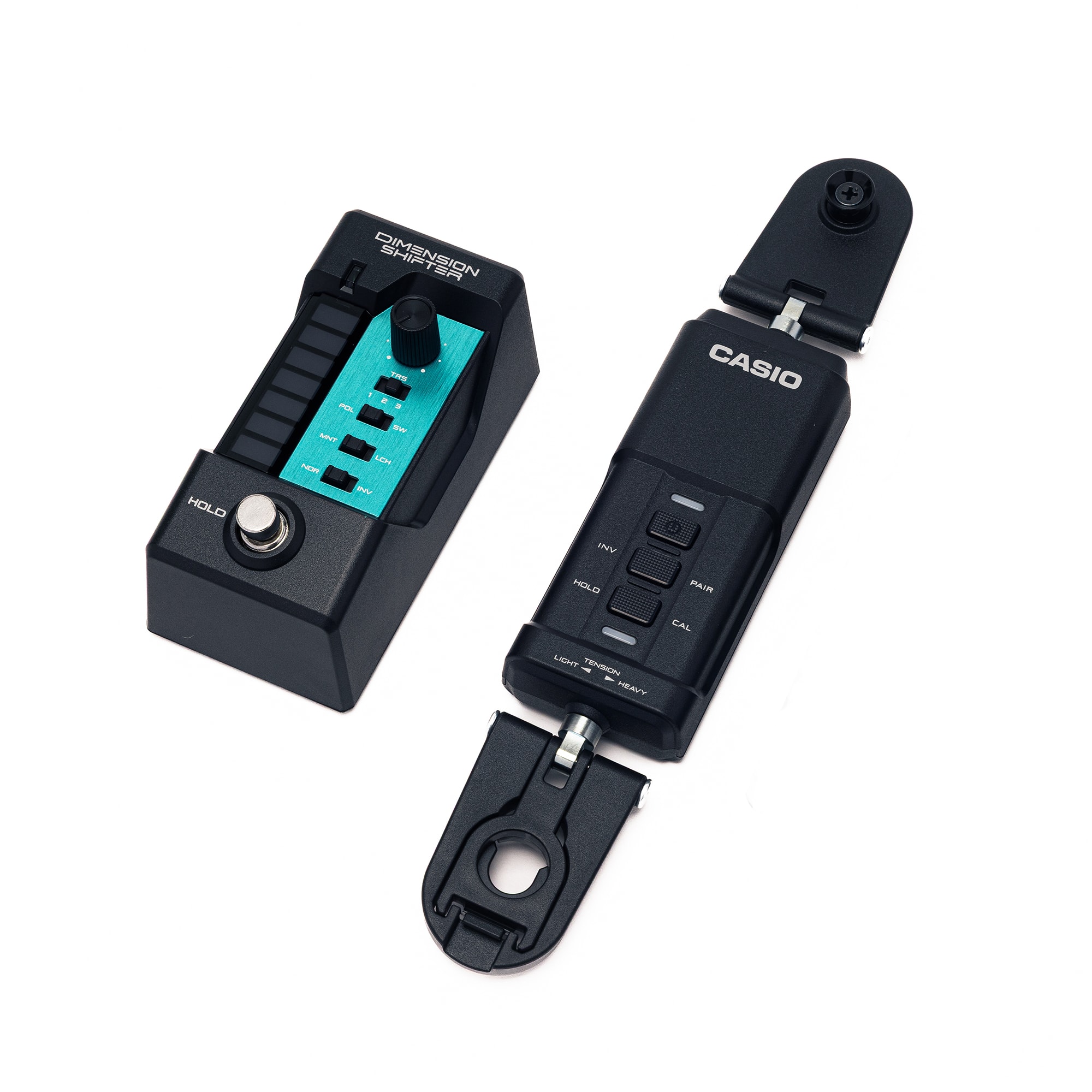
The Casio Dimension Shifter (model DN-SE10) is a wireless expression controller that mounts on your guitar strap instead of sitting on the floor. Lower the guitar against the strap and a built-in spring stretches, sending that motion over Bluetooth to a receiver pedal. The receiver rides the expression input of whatever effect you point it at.
How it works
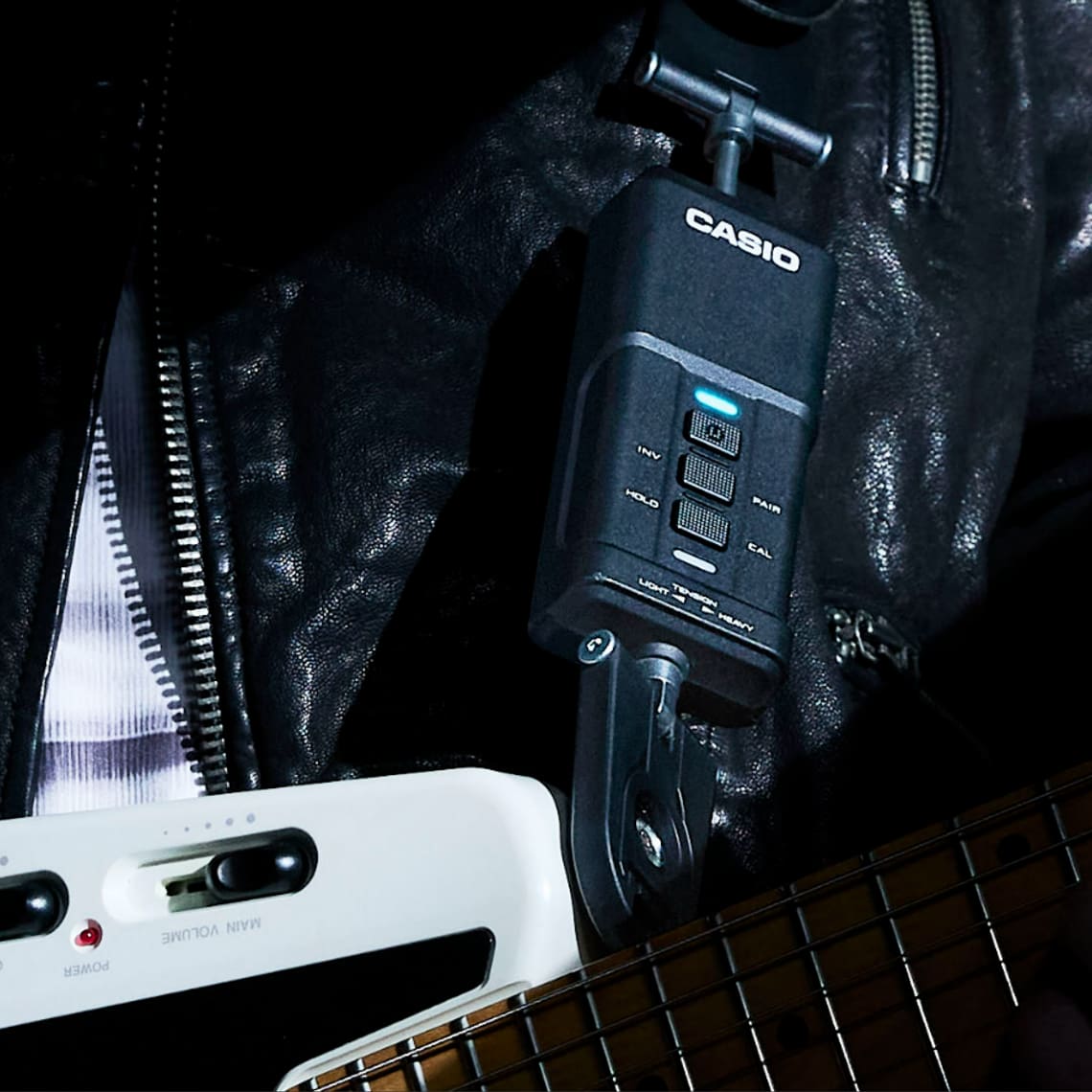
It is a two-piece system. A small transmitter clips between your guitar and strap. A receiver pedal lives on your board. When you lower the guitar against the strap, the transmitter's spring compresses and extends, and that movement travels to the receiver over Bluetooth 5.1. The receiver's 1/4-inch TRS output plugs into an effect's expression or control jack, the same place a foot treadle would go. Anything you would normally ride with an expression pedal, you now ride with body movement.
CJ Hockenbury's video shows the mounting in practice. The transmitter attaches through the strap, its underside has urethane rubber to protect the finish, and after about two weeks of use he reports no damage. He also notes the tension is adjustable, so you do not have to pull hard. With the weight of the guitar doing some of the work, he moves it "with one finger."
Playing effects with your body instead of your feet
The everyday pitch is simple: you stop being tied to one spot. Hockenbury frames it from a performer's angle. He moves constantly on stage, and having to walk back to the pedalboard for a wah or a pitch effect breaks the moment. Moving that control up onto the strap keeps him playing. Casio positions this freedom as the core idea, and both reviewers value it in their own words.
What it does that a foot pedal can't
A few moves are awkward or impossible with your feet.
Control two parameters at once. One foot cannot independently control two expression treadles at the same time. Michael Weber pairs the Dimension Shifter with a regular expression pedal so he can ride two things together, such as volume with the strap and effect depth with the treadle. Casio lists this dual control as a feature.
Switch, not just sweep. Set the receiver to switch mode and a downward pull changes presets or toggles effects, either momentary or latching. No stomping required.
Freeze and flip. The HOLD control locks the current position, so you can find an exact phaser speed or wah placement and pin it there. The INV control reverses the throw.
Use familiar effects in a different way. Across his demo, Hockenbury rides it for violin-style volume swells, an infinite delay freeze, wah, octave-down heaviness, pitch-up leads, and deliberately glitchy textures. A treadle can reach most of those too; the difference is that here you shape them with body movement instead of your foot.
The B-bender connection
Plenty of players will reach for the B-bender comparison, and that is no accident. Weber calls the concept a "beyond bender," and inventor Leo Fuji confirms the lineage directly. He wanted a B-bender, found even used ones expensive, and prototyped the idea after noticing the sliding lid on his child's chopstick case. Casio markets the concept around being the "world's first expression strap."
The difference matters. A mechanical B-bender, invented by Byrds bandmates Gene Parsons and Clarence White, raises the B string when you pull the neck. The Dimension Shifter uses that same familiar motion but points it at any effect parameter, with nothing routed into the guitar. Because no string is physically bending, Weber shows you can even map intervals a real B-bender cannot reach.
What the demonstrations reveal
Watch the two independent reviews back to back and a few things line up, while a couple are worth keeping narrow.
The point both reviewers keep circling is that the controller changes how you use effects, not just where you can stand while using them. Weber and Hockenbury each came away reaching for familiar effects in fresh ways, which lands harder than the wireless angle the box leads with. Both also describe the feel as more physical than working a foot pedal, and Weber goes a step further, saying it lets him "dial in very specific spots" more finely than a treadle would.
Latency barely comes up as a problem. Casio lists about 20 milliseconds, and Hockenbury's own estimate of roughly 20 milliseconds maximum matches that, though it is worth remembering that is one player's impression alongside the spec, not a wide sample.
Hockenbury is refreshingly candid that he expected a gimmick and ended up rating it 4.8 out of 5. Both he and inventor Leo Fuji also raise an accessibility angle that is worth weighing carefully: Weber points to players who cannot comfortably use a floor pedal, and Fuji recounts a wheelchair user at NAMM who was glad to control expression again. That is a promising thing to hear, but treat it as a couple of firsthand observations rather than a proven claim.
Setup and compatibility
Setup is short. Attach the transmitter through your guitar and strap, run a TRS cable from the receiver to your effect's expression or control jack, and power on. The two halves pair automatically. Casio includes a silicone cover to protect the finish, and Hockenbury notes a mono cable can work too, though the function varies by device.
On compatibility, be realistic rather than absolute. It should work with most effects that provide a compatible expression or control input. The receiver has a three-position TRS switch to match common wiring standards: position one covers Boss, Kemper, and Strymon; two covers Zoom; three covers Line 6. As Weber puts it, one of the three usually works for a given pedal. That is broad coverage, not a guarantee, since expression inputs vary by wiring and implementation.
Limitations and learning curve
The honest catches, straight from the sources:
- It is a controller, not an effect. It rides a pedal's expression input, so you need at least one expression-capable effect for it to do anything.
- Grip matters. The throw depends on your strap and clothing. Weber's tip: leather grips the shoulder best, and if things are slippery you can push the guitar body with your elbow or pick hand. He estimates about 30 seconds to find the feel.
- Extra bits. The receiver needs power (pedalboard supply or the sold-separately AD-0913S adapter) and a standard TRS cable, and the transmitter runs on two AAA batteries.
Who it's for
If you already like riding an expression pedal but dislike being anchored to one spot, this is aimed at you. It rewards ambient and experimental players, from feedback swells to glitch textures, and anyone who wants B-bender-style expressiveness without a guitar mod. Weber and Fuji also raise a possible accessibility angle for players who cannot easily use a floor pedal, which is worth weighing as an attributed point rather than a guarantee.
Fast Facts
- Model: DN-SE10
- Price: $299.99 (Sweetwater)
- Connection: Bluetooth 5.1, up to about 30 ft (10 m)
- Latency: Approx. 20 ms
- Output: 1/4-inch TRS to an effect's expression or control input
- Compatibility: 3-position TRS switch (Boss/Kemper/Strymon, Zoom, Line 6, and more)
- Transmitter power: 2 x AAA, approx. 20-hour battery life
- Receiver power: AC adapter (AD-0913S, sold separately) or pedalboard supply
- Weight: Transmitter approx. 0.33 lb, receiver approx. 0.32 lb
Video Library
Best independent walkthrough. CJ Hockenbury's product video is the most complete independent tour. He covers mounting and strap technique (around 1:31), the TRS connection (1:50), a run of use cases (about 2:40 to 3:57), then range and latency near 4:41. Worth it for a real-world take from a player who expected a gimmick.
Best controls and B-bender demo. Michael Weber's walkthrough is the deepest tour of the controls. Timestamp links: the B-bender-style pitch section starts near 1:38; dual-expression use around 4:39; HOLD near 3:43.
Creator story. Leo Fuji's interview (in Japanese) explains why he built it. The chopstick-case origin runs from about 0:50, and the NAMM accessibility moment is near 4:33.
Artist performances. Yvette Young (Covet) and Marty Friedman show the controller in musical context. These are Casio artist showcases, useful for sound and feel rather than independent review.
Quick creative example. Jordan's short is a fast look at a single creative use, and Casio's launch promo gives a first visual impression.
FAQ
How much is the Casio Dimension Shifter?
It sells for $299.99 at Sweetwater. Casio has not published an MSRP, so check the retailer for the latest price.
Is it wireless?
Yes. The transmitter and receiver pair over Bluetooth 5.1 with up to about 30 feet (10 m) of range and roughly 20 ms of latency, which Casio and reviewer CJ Hockenbury both put near that figure.
Does it work with any pedal?
It should work with most effects that have an expression or control input. A three-position TRS switch on the receiver matches common wiring standards (Boss/Kemper/Strymon, Zoom, Line 6, and more), but compatibility is not guaranteed for every pedal.
Can I use it with a regular expression pedal?
Yes, and that pairing is a highlight. Together they let you control two parameters at once, which one foot cannot do with two treadles.
What powers it?
The transmitter takes two AAA batteries (about 20 hours). The receiver runs on a pedalboard supply or Casio's sold-separately AD-0913S adapter.
Where to buy
Buy from Casio. The Dimension Shifter is sold on the official DN-SE10 page. Casio does not list a price on that page, so use a retailer for current pricing.
Buy from Sweetwater. It sells for $299.99 at Sweetwater. Stock and pricing change, so confirm before ordering.
- Introduction
- The bigger idea
- What is the Casio Dimension Shifter?
- How it works
- Playing effects with your body instead of your feet
- What it does that a foot pedal can't
- The B-bender connection
- What the demonstrations reveal
- Setup and compatibility
- Limitations and learning curve
- Who it's for
- Fast Facts
- Video Library
- FAQ
- How much is the Casio Dimension Shifter?
- Is it wireless?
- Does it work with any pedal?
- Can I use it with a regular expression pedal?
- What powers it?
- Where to buy


